In today’s highly competitive manufacturing environment, companies are under increasing pressure to bring products to market faster while maintaining quality and controlling costs. Traditional manufacturing methods such as injection molding can be expensive and time-consuming, especially during early-stage development or when only small quantities are required.
This is where vacuum casting becomes a powerful and practical solution.
Also known as urethane casting, vacuum casting is widely used for rapid prototyping and low-volume production. It offers an ideal balance between speed, cost-efficiency, and quality—making it a preferred choice for engineers, product designers, and sourcing professionals worldwide.
In this article, we’ll explore how vacuum casting works, its advantages, applications, and why it plays a critical role in modern product development.
What is Vacuum Casting?
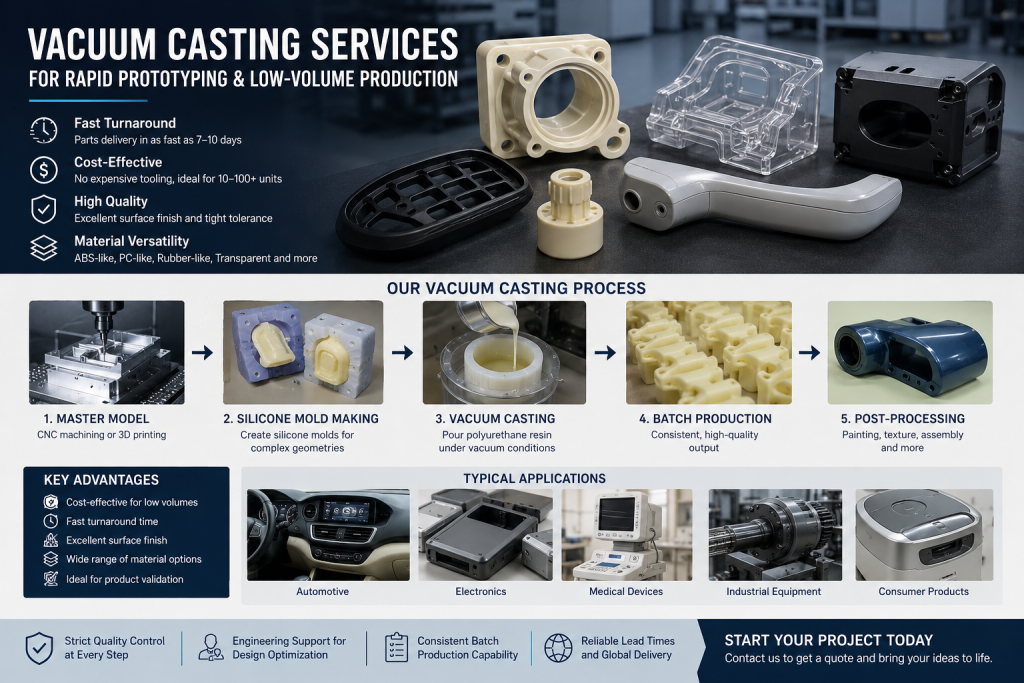
Vacuum casting is a manufacturing process that involves pouring liquid polyurethane (PU) resin into a silicone mold under vacuum conditions. The vacuum environment removes air bubbles, ensuring that the final parts are highly detailed, smooth, and free from defects.
The process typically starts with a master model, which is created using CNC machining or 3D printing. This master model is then used to produce a silicone mold that can replicate the part multiple times with high consistency.
Once the mold is ready, liquid material is poured into it inside a vacuum chamber. After curing, the part is removed, post-processed, and prepared for use.
A single silicone mold can usually produce 10 to 25 parts, depending on complexity and material selection.
The Vacuum Casting Process Step by Step
Understanding the process helps highlight why vacuum casting is both efficient and reliable:
1. Master Model Creation
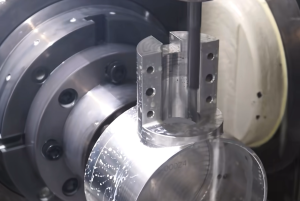
The process begins with a high-precision master model. This can be produced through CNC machining for tight tolerances or 3D printing for complex geometries.
2. Silicone Mold Fabrication
Liquid silicone is poured around the master model and cured to create a flexible mold. Once hardened, the mold is cut open and the master model is removed.
3. Vacuum Casting
Polyurethane resin is mixed and poured into the silicone mold inside a vacuum chamber. The vacuum removes trapped air, ensuring defect-free parts.
4. Curing and Demolding
The material cures inside the mold, after which the part is removed and inspected.
5. Post-Processing
Additional finishing processes such as painting, polishing, texture application, or assembly are carried out based on project requirements.
Key Advantages of Vacuum Casting
Vacuum casting offers several important advantages, especially for companies working on prototypes or low-volume production.
1. Cost-Effective for Small Batches
One of the biggest benefits of vacuum casting is its affordability. Unlike injection molding, which requires expensive metal tooling, vacuum casting uses silicone molds that are much cheaper and faster to produce.
This makes it ideal for production runs of 10 to 100+ units, where traditional tooling costs would be difficult to justify.
2. Fast Turnaround Time
Speed is critical in product development. Vacuum casting significantly reduces lead times compared to conventional manufacturing methods.
- Silicone molds can be produced quickly
- Parts can be delivered in as fast as 7–10 days
- Design iterations can be completed rapidly
This allows companies to accelerate product validation and reduce time-to-market.
3. Excellent Surface Finish and Detail
Vacuum casting is known for its ability to replicate fine details and complex geometries.
The silicone molds capture even the smallest features, resulting in parts with:
- Smooth surfaces
- High dimensional accuracy
- Detailed textures
This makes vacuum casting suitable for both functional testing and visual prototypes.
4. Wide Range of Material Options
Vacuum casting supports a variety of polyurethane materials that simulate different engineering plastics.
Common material options include:
- ABS-like materials for rigid parts
- PC-like materials for impact resistance
- Rubber-like materials for flexibility
- Transparent materials for optical applications
This versatility allows engineers to test different product characteristics without committing to final production materials.
5. Ideal for Product Validation
Before moving to mass production, companies need to verify their designs through testing and market feedback.
Vacuum casting is perfect for:
- Functional testing
- Design verification
- Marketing samples
- Pre-production runs
It helps identify potential issues early, reducing risks and avoiding costly changes later in the development cycle.
Typical Applications of Vacuum Casting
Vacuum casting is widely used across multiple industries due to its flexibility and cost advantages.
Automotive Industry
Used for interior and exterior components, dashboard parts, and functional prototypes.
Electronics Industry
Ideal for housings, enclosures, connectors, and structural components.
Medical Devices
Used for prototype parts that require high precision and smooth finishes.
Industrial Equipment
Suitable for functional parts and small-batch components.
Consumer Products
Commonly used for product casings, design models, and market testing samples.
Vacuum Casting vs Injection Molding
Many companies struggle to decide between vacuum casting and injection molding.
Here’s a simple comparison:
| Feature | Vacuum Casting | Injection Molding |
|---|---|---|
| Tooling Cost | Low | High |
| Lead Time | Fast | Longer |
| Production Volume | Low to Medium | High |
| Flexibility | High | Limited |
| Ideal Stage | Prototyping & Pre-production | Mass Production |
In most cases, vacuum casting is the best choice before committing to injection molding.
Why Vacuum Casting is Critical in Modern Product Development
Modern product development requires agility. Companies need to test ideas quickly, adapt designs, and respond to market feedback.
Vacuum casting enables this by:
- Reducing development risks
- Lowering upfront investment
- Allowing rapid design iterations
- Providing production-like parts for validation
It effectively bridges the gap between concept and mass production.
Why Choose Our Vacuum Casting Services?
At JC Precision Craft, we go beyond manufacturing—we provide complete support throughout your product development journey.
✔️ High-Quality Standards
We implement strict quality control at every stage, ensuring precision and consistency.
✔️ Reliable Batch Production
Our processes are optimized for stable, repeatable results across small batches.
✔️ Engineering Support
Our team works closely with you to optimize designs for manufacturability and performance.
✔️ Fast & Reliable Delivery
We understand the importance of timelines and ensure dependable lead times for every project.
From Prototype to Production
Whether you are developing a new product or preparing for market launch, vacuum casting provides the flexibility and speed you need.
From initial prototypes to low-volume production, we ensure your parts meet both functional requirements and aesthetic expectations.
Start Your Project Today
Looking for a reliable vacuum casting partner?
At JC Precision Craft, we are ready to support your project with precision, speed, and expertise.
Contact us today to request a quote and bring your ideas to life.